Legislation
Learn More about The Lousiana Justice for Survivors Act
Freedom & Safety in Louisiana for Survivors of Violence
The Justice for Survivors Act would give judges the power to sentence survivors under lower sentencing ranges if the survivor proves that the abuse, sexual assault, or trafficking was a substantial contributing factor in the survivor’s participation in the offense. It would also give survivors already in prison a chance to apply for re-sentencing.
The JSA has multiple layers of protections to ensure that individuals whose incarceration is not directly linked to abuse or trafficking cannot receive relief under this law.
Survivors should not have to choose between prison or death.
This legislation is a recommendation from research done in 2021 by the Survivor Informed Task Force which included the LDAA, the Sheriff’s Association, the LA Supreme Court, Department of Corrections, survivors, and advocates. Research by the SITF found that, “Preventing the criminalization of survivors and providing relief for those already criminalized will not only serve to heal and reduce violence, but also is an opportunity for the State to save and re-direct money to true public safety.” The 2023 Justice for Survivors Act received unanimous recommendation as a Legislative Priority from the Human Trafficking Prevention Commission.
What The JSA Does
Decriminalizing Survorship
The JSA gives judges the power to sentence survivors under lower sentencing ranges if the survivor proves that the abuse, sexual assault, or trafficking was a significant contributing factor in the survivor’s participation in the offense.
A Path for Incarcerated Survivors
Passage of the act would give survivors of domestic violence, assault, and human trafficking who are already in prison a chance to apply for a re-sentencing.
Delivering Targeted Justice
The JSA has multiple layers of protections to ensure that individuals whose incarceration is not directly linked to abuse or trafficking cannot receive relief under this law.
Documents created by or about the JSA. Click the image to open document.
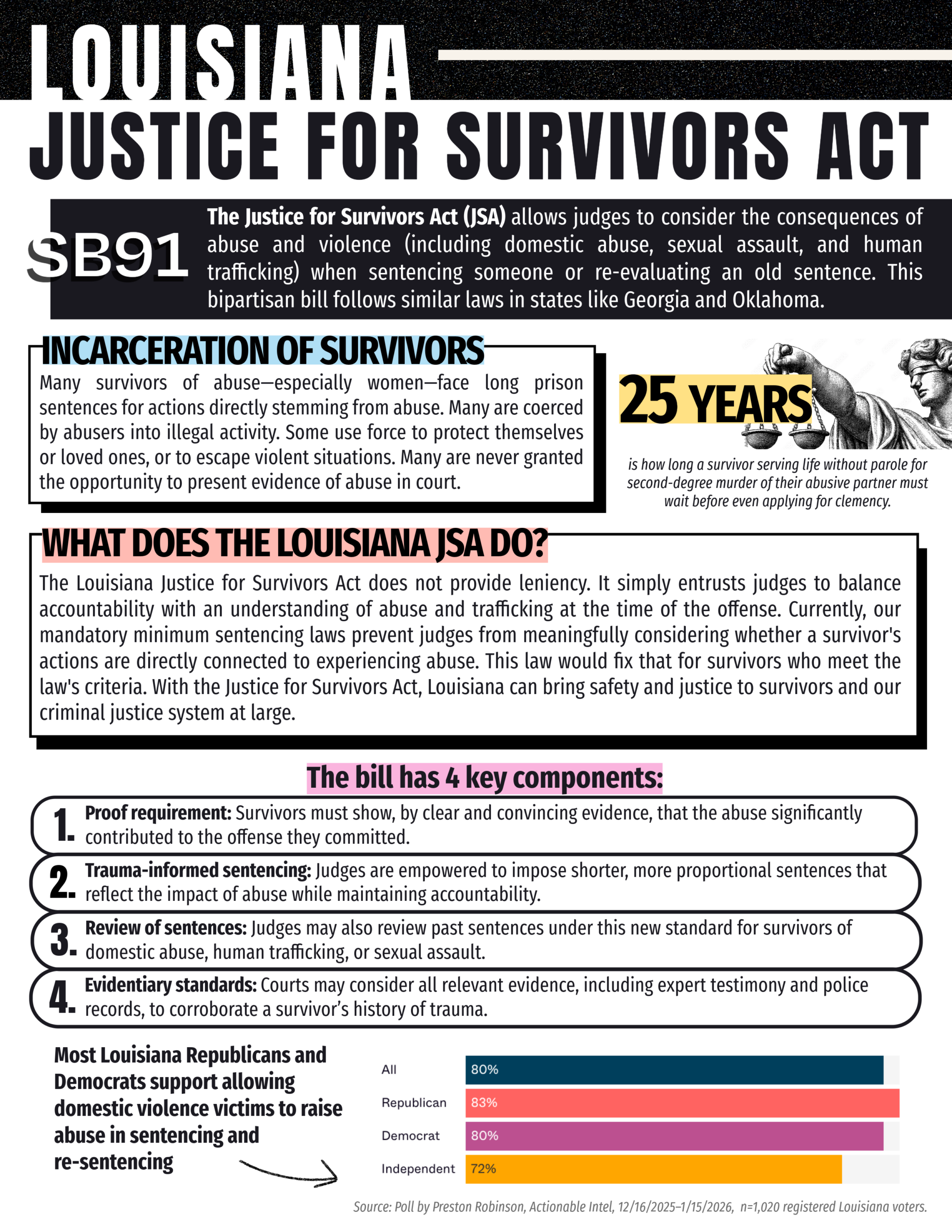
2026 JSA Fact Sheet
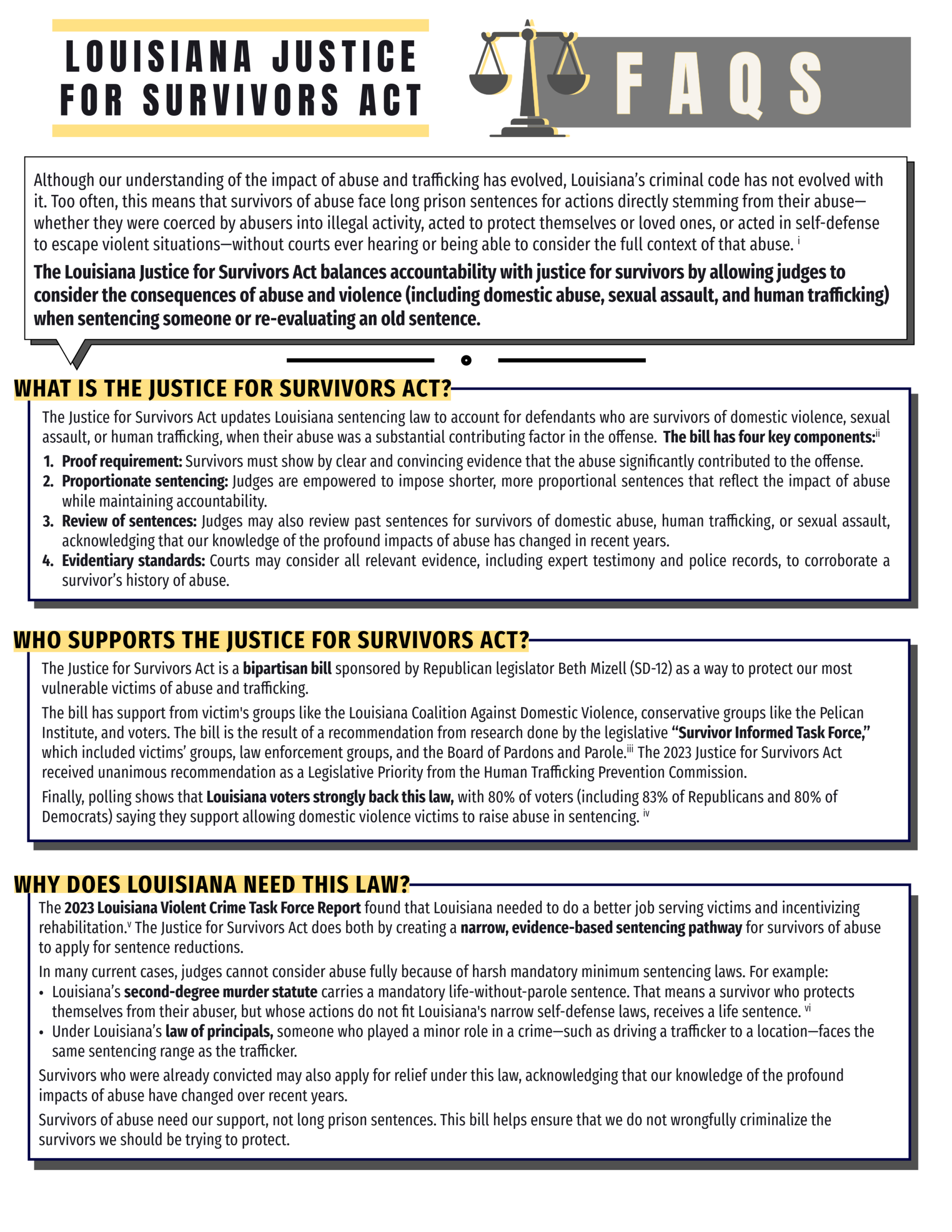
Louisiana Justice for Survivors Act FAQs
Survivor Informed Task Force Final Report and Recommendations
Louisiana Human Trafficking Prevention Commission 2022 Annual Report
The JSA received unanimous recommendation as a legislative priority from the HT Prevention Commission
FAQ’s
Have these laws been studied in Louisiana?
Yes. The Justice for Survivors Act is a recommendation from research done by the legislative “Survivor Informed Task Force,” which included victim’s groups, law enforcement, the LDAA, the LA Supreme Court, and the Board of Pardons and Parole. In 2023, another task force studied this issue, and reached similar conclusions.
Have other states passed similar legislation?
Yes. Justice for Survivors laws have been passed in several other states, including most recently in Georgia (2025) and Oklahoma (2024), where they passed by near-unanimous votes. Many other states are considering justice for survivors legislation. The American Legislative Exchange Council (ALEC) also recently released model justice for survivors legislation. Learn More
“This law is gender-neutral. If somebody is a survivor of domestic abuse and that abuse is connected to the offense, then they should have the right to be heard. Period.” -Jon Echols, bill author of Oklahoma’s Survivors Justice Act.
Why can’t survivors just rely on the clemency process?
The clemency process can be helpful in limited situations, but it is insufficient to address this problem. A number of survivors are serving life without parole sentences for second-degree murder of their abusive partner, but individuals serving life sentences cannot even apply for clemency prior to serving 25 years in prison. When an individual can finally apply, their success depends on a variety of factors that are unrelated to the context of abuse and trafficking. By contrast, Justice for Survivors laws provide a legal right to relief, if the survivor can meet the criteria. Court is a more appropriate mechanism to resolve factual disputes and address the relevant question in these cases: whether survivors’ sentences match their level of culpability.
Will these laws apply to individuals who were abused as children and later committed horrible crimes?
No. These laws will only apply in situations where the survivor proves that she is a victim of abuse or trafficking at the time of the incident. For any violent charge, the law will only apply if either the abuser/trafficker was the alleged victim, or the abuser/trafficker forced the survivor to participate in the crime.
Can abusers and traffickers use these laws to argue they’re the victims, and they should get out of prison?
There are no known examples of any abuser getting out of prison using these laws in any state. These laws have very high standards of proof, requiring strong evidence of victimization to receive relief. If someone who does not fit the law applies for relief, a judge will deny the application.
Can judges take the abuse into account under the current law?
Judges can consider abuse and trafficking when deciding what sentence to give someone within a statutory range, but many charges have mandatory minimum sentences which restrict judges from imposing the sentence they believe is appropriate. This law would give judges the ability to impose a sentence that actually reflects the survivor’s level of culpability, if the survivor meets the strict criteria of the law.
Does the law apply to survivors who are already in prison?
Yes, provided that they meet the strict criteria of the law. This is important because the older cases are the most egregious miscarriages of justice. There are survivors who have been in prison for decades based on stereotypes and outdated understandings about intimate partner violence in trafficking.

Are you a journalist or media-maker interested in covering the Justice for Survivors Act?
Get in touch! Use the form below to send the details.